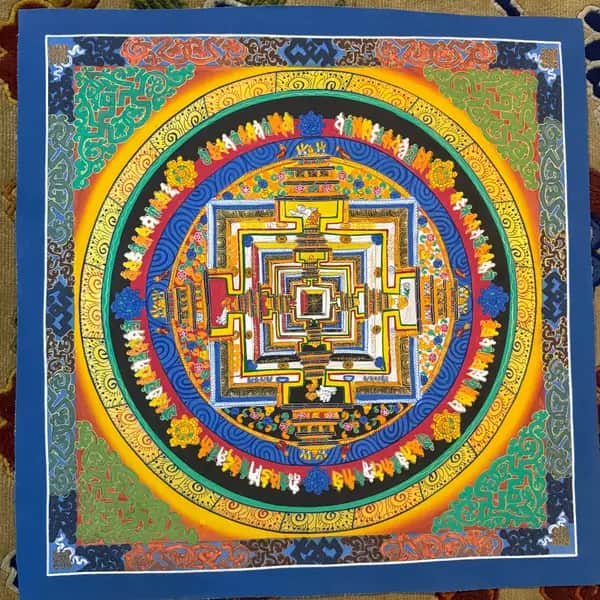
Kalachakra Mandala
$130.00
Inc. Duties & TaxesShips within 3-5 business days via insured express courier.
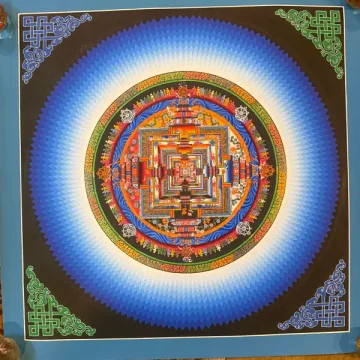
The halo in this painting is blue, white at the core and deepening through several tones to a saturated blue at its outer edge, all of it over a dark brown ground. Endless knots in green and blue mark the corners, and concentric rings of red and blue close around the central palace. The effect is cool, which is uncommon in a subject more often painted warm. The function of a thangka is instructional. Every element is set by iconographic convention so that a practitioner can rely on the image while building the same form in visualisation. Treated as a sacred object in Tibetan households and monasteries, it is hung at the height of a seated person and kept clear of clutter. At this size the piece works above a shrine, in a meditation corner, or as the single hung object on a short wall. It does not need company to hold its place.
Specification
• Hand Painted
• Materials: Semi-Precious Natural Stone Minerals
• Base: Cotton Canvas
• Size: 50 x 50 cm (19.7 x 19.7 inches)
• Origination: Nepal
• Supplied: Rolled in an archival tube, unframed, with a certificate of authenticity
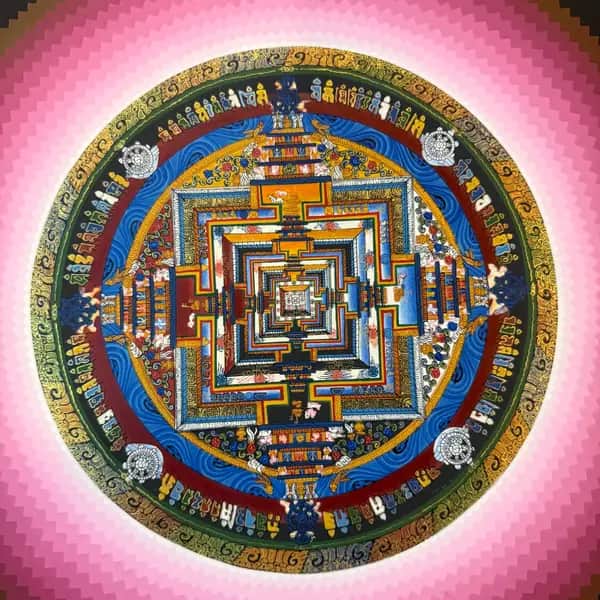
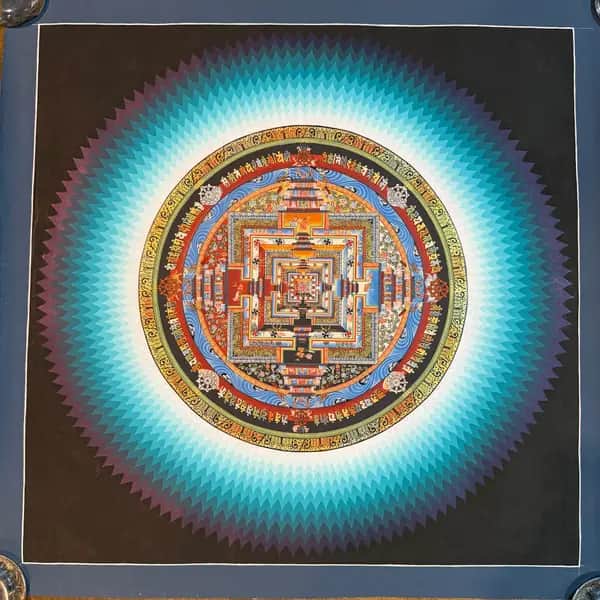
• Shipping: Free insured worldwide shipping, dispatched within 3 to 5 business days The teaching behind this diagram is set out in the Kalachakra Tantra, a text of the Vajrayana canon. The tradition holds that the Buddha taught it at Dhanyakataka in southern India, and that it passed from there to Shambhala, where a line of kings preserved and commented on it before it returned to India and then reached Tibet. That transmission accounts for the mandala's unusual public standing. The 14th Dalai Lama is known worldwide for conferring the Kalachakra empowerment at very large open gatherings, some numbering in the tens of thousands and beyond, which is rare for a tantric initiation. He confers the empowerment; the tantra and its diagram are many centuries older than any living teacher. The cool halo here carries no fixed doctrinal meaning. Ground colour and halo colour are the painter's decision within the rules of the layout, and workshops in Nepal vary them on purpose, so that two mandalas built on an identical plan do not read alike on the wall. Because every thangka is painted individually, no two pieces are the same. Small differences in line, ground colour and pigment tone are the signature of hand work and not a defect.
blogs
Stories from our workshop and the artists behind each piece.
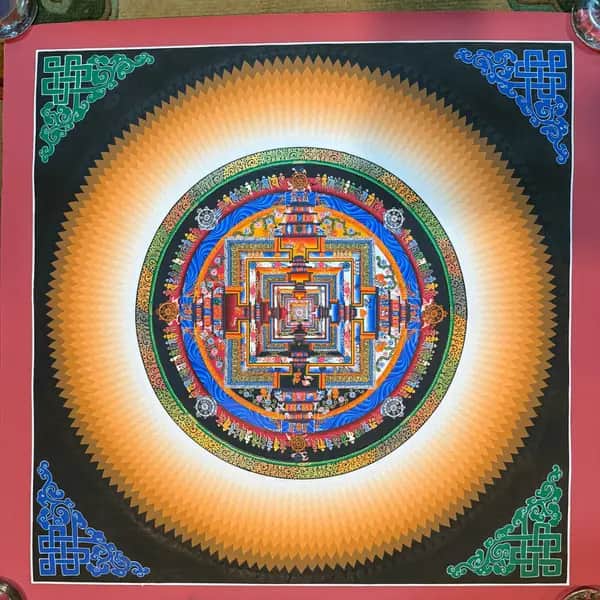
Kalachakra Mandala
19.7×19.7 in