Overview
Green Tara appears compassionate yet alert. Every line, color, and gesture carries layered meaning.
Blog Article
Learn the iconographic grammar behind Green Tara thangka paintings, from lotus seat to mudra.
Published April 16, 2026
Green Tara appears compassionate yet alert. Every line, color, and gesture carries layered meaning.
Green Tara (Sanskrit: Shyama Tara, Tibetan: Drolma) is one of the most widely venerated female deities in Tibetan and Newar Buddhism. Legend holds that she was born from a lotus that grew in a lake of Avalokiteshvara's tears, shed as he wept for the endless suffering of beings he could not save alone. Where Avalokiteshvara embodies compassion in contemplation, Tara embodies compassion in motion — she is the deity practitioners call on when they need help now, not eventually. Twenty-one forms of Tara appear across the tradition, each a different color and each addressing a different kind of obstacle, but Green Tara is the root form from which the others are said to emanate.
In thangka color language, green sits between the coolness of blue wisdom and the warmth of red compassion-in-action, and that is precisely Tara's role. Green represents swift enlightened activity: the willingness to act immediately on behalf of someone who is suffering, rather than waiting for the 'correct' contemplative moment. Painters reinforce this with a palette that stays saturated and alive rather than muted — a well-made Green Tara thangka should feel like it could move at any second.
Answers to the questions readers ask most about this topic.
Editorial Team
Super Admin
A well-known story tells of a monk who, after lifetimes of practice, was told by other monks that a woman's body was too impure a vessel to reach enlightenment and that Tara should aspire to be reborn as a man. She refused. She vowed to remain in a woman's form, lifetime after lifetime, until she attained full Buddhahood, precisely to prove that gender was never the obstacle to begin with. Her attainment as Green Tara is treated in the tradition as fulfillment of that vow — which is one reason she is so frequently invoked by practitioners regardless of gender, and why she carries a somewhat different emotional register from the more serene, seated deities: there is defiance in her posture as much as compassion.
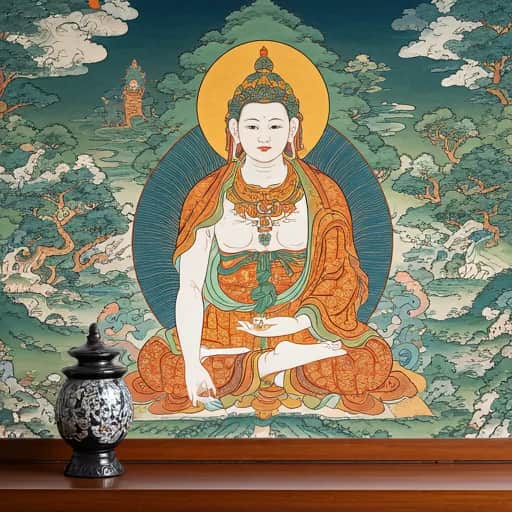
Look closely at a Green Tara thangka and you will notice she is not fully cross-legged in the classic meditative lotus posture. Her right leg is extended, foot resting on a small lotus, while her left leg remains folded — a posture called lalitasana, the 'royal ease' pose. This is deliberate: one leg stays grounded in meditative stability, the other is already extended toward the viewer, ready to rise and act. Her right hand shows varada mudra, the gesture of granting boons, palm open and turned outward. Her left hand is held at the heart in vitarka mudra, thumb and forefinger touching, while holding the stem of a blue utpala (night lotus) flower that blooms just past her shoulder. Read together, the body is a sentence: I am steady, I am generous, and I am already moving toward you.
A traditional thangka is never just a portrait — it is a whole cosmology compressed onto cloth. Around Tara's head sits an aureole, usually rendered as radiating light or a stylized lotus-petal halo, marking her as an enlightened being rather than an ordinary figure. Her throne or lotus base is often flanked by smaller attendant figures or offering goddesses. The background typically resolves into a Himalayan-style landscape — stylized mountains, clouds, and sometimes a small monastery — which situates the deity in a timeless, idealized version of the practitioner's own world rather than a mythic elsewhere. Every element in the frame is there to be 'read' in sequence, the way you would read a page of scripture, not simply looked at as decoration.
The rest of the palette carries its own grammar. White accents (often in her undergarment or pearls) signal purity of intention. Deep red in her outer robe signals the transformation of desire into compassionate action rather than its suppression. Gold detailing — on jewelry, crown, and the fine linework along fabric edges — represents enlightened qualities that do not tarnish: wisdom, generosity, and fearlessness rendered in a material that does not corrode. Traditional Newar ateliers in the Kathmandu Valley still favor mineral-based pigments (malachite green, cinnabar red, lapis-derived blue, and genuine gold leaf) over synthetic paint precisely because these colors hold their tone for centuries rather than fading within a generation.
Kathmandu Valley's Newar artists have painted thangka for over a thousand years, and the technical process has changed surprisingly little. A cotton canvas is stretched on a wooden frame and treated with a gesso of chalk and hide glue, then burnished with a smooth stone until the surface is dense enough to hold fine linework without the fibers showing through. The artist sketches the deity's proportions using a strict geometric grid — iconometric measurement is not optional in this tradition, since a Tara whose proportions are 'off' is considered doctrinally incorrect, not just aesthetically weak. Only after the linework is finalized does color go in, background first, then figure, with gold reserved for the very last stage so it is not scuffed by later brushwork.
In practice, a Green Tara thangka is rarely just wall art. It typically hangs at eye level from a seated position, so a practitioner can meet her gaze during mantra recitation — commonly Om Tare Tuttare Ture Svaha — and use the image as a visual anchor when the mind wanders during breath-led contemplation. Some practitioners recite a short supplication before beginning formal meditation, treating the thangka less like an object of aesthetic appreciation and more like a doorway: color and posture are meant to dissolve into felt qualities of readiness and compassion rather than remain 'just a picture' on the wall.
Hand-painted mineral pigments are remarkably stable, but they are still vulnerable to two things: direct sunlight and humidity. UV exposure will slowly bleach even natural pigments over years, so hang your thangka away from a window that gets direct afternoon sun. Humidity above roughly 65% can loosen the hide-glue ground layer over time, causing paint to flake at the edges, so a dry interior wall is safer than a bathroom or an exterior wall in a humid climate. Most collectors leave the traditional silk brocade mounting on rather than reframing behind glass — the fabric border is part of the piece's meaning, not just packaging, and it lets the canvas breathe.